
ASA-CF print settings
Carbon Fibre Reinforced ASA · Advanced
ASA-CF (Carbon Fibre Reinforced ASA) prints at 240-270°C with the bed at 90-110°C. It needs an enclosure. Dry the filament before printing.
ASA with carbon fibre: UV stability and heat resistance, plus stiffness and a matte finish. The natural choice for an outdoor part that also has to hold its shape under load.
Settings at a glance
Ranges are typical manufacturer-published figures for this material class, not measurements we took. Always start with your filament maker’s own numbers where they differ. The price is an indicative street price for a 1 kg spool, not a live quote.
Good for
- Outdoor structural brackets
- Roof and garden fittings
- Automotive exterior parts
- Antenna and sensor mounts
Avoid for
- Brass nozzles
- Unventilated rooms
- Open-frame printers
The problem people actually hit
It warps like ASA and wears nozzles like a composite, so it inherits both problems at once. Enclose the printer and fit a hardened nozzle before the first print rather than after.
Drying
Hygroscopic. Dry at 70-80C for 4 hours.
Buying ASA-CF
ASA-CF is stocked unevenly by general retailers. A specialist supplier is usually the better source, both for availability and because they publish the spec sheet. Typical street price is $40-70 per 1 kg spool.
Check before you order
- Diameter 1.75mm unless your printer takes 2.85mm. Check before ordering, not after.
- Published diameter tolerance. ±0.02mm is good, ±0.05mm is loose and shows up as inconsistent extrusion.
- Vacuum-sealed with desiccant. Hygroscopic filament that shipped open has already absorbed moisture and will need drying before its first print.
- Fit a hardened nozzle first. This material is abrasive and will widen a brass nozzle within a print or two.
- Confirm you have an enclosure before buying. Without one this material will warp regardless of spool quality.
Specialist suppliers
Deep engineering-material catalogue and published spec sheets, including grades general retailers do not stock.
Specialist stockist with strong coverage of nylon and carbon-fibre filled materials.
Named because they stock this class of material and publish specifications. We have no commercial relationship with either, and these are ordinary links.
Not sure this is the right material? Compare all materials.
What you need to print ASA-CF
Gear that ASA-CF genuinely requires, with the specification that decides whether a given unit will actually work.
Filament dryer
Must reach at least 70C
ASA-CF will not print cleanly wet, and many budget dryers stop at 55-60C. Check the maximum temperature before buying, not the marketing copy.
See filament dryer on AmazonPrinter enclosure
Fully closed, with a door
ASA-CF warps when a draught cools the part unevenly. An enclosure holds chamber heat steady, which fixes lifting corners and split layers more reliably than any slicer setting.
See printer enclosure on AmazonBed adhesion
PEI sheet sized to your bed, or a PVP glue stick
ASA-CF lifts at the corners before it fails anywhere else. A textured PEI surface plus a thin glue layer holds the first layer down while the chamber comes up to temperature.
See bed adhesion on AmazonHeat-set threaded inserts
Brass, M3 unless your design says otherwise
Printed threads strip. If you are making outdoor structural brackets out of ASA-CF, melting brass inserts in gives you a metal thread that survives being undone more than once.
See heat-set threaded inserts on AmazonHardened steel nozzle
Hardened steel or ruby, matching your hot end
ASA-CF is abrasive and will widen a brass nozzle within a print or two. Fit the hardened nozzle before the first print - the symptom, worsening underextrusion, looks like a dozen other faults.
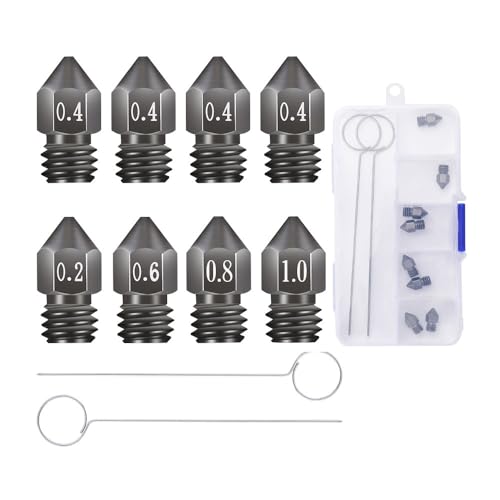 Creality · Hardened steel nozzles, MK8Hardened steel for abrasive filament. MK8 is a thread pattern, not a universal fit
Airtight storage with desiccant
Sealed container plus rechargeable desiccant
Drying a spool once achieves nothing if it sits open afterwards. Storage is what keeps the filament usable between prints.
See airtight storage with desiccant on AmazonAs an Amazon Associate we earn from qualifying purchases. Links above are affiliate links, and using them costs you nothing extra.
ASA-CF questions
- What temperature do you print ASA-CF at?
- ASA-CF prints at a nozzle temperature of 240-270C with the bed at 90-110C. Start at the lower end of the nozzle range and raise it in 5C steps until layers bond cleanly.
- Does ASA-CF need an enclosure?
- Yes. ASA-CF needs an enclosure. Without one the part cools unevenly, corners lift off the bed and layers split partway up the print.
- Do you need to dry ASA-CF?
- Hygroscopic. Dry at 70-80C for 4 hours.
- What is ASA-CF good for?
- ASA-CF suits outdoor structural brackets, roof and garden fittings, automotive exterior parts, antenna and sensor mounts. Avoid it for brass nozzles, unventilated rooms, open-frame printers.
- How much does ASA-CF cost?
- A 1 kg spool of ASA-CF typically sells for $40-70. That is an indicative street price rather than a live figure, so check the retailer for today's cost.
ASA-CF or ASA?
ASA (Acrylonitrile Styrene Acrylate) prints at 235-255°C with a 90-110°C bed and needs an enclosure. ABS reformulated to survive sunlight. Same strength and heat resistance, far better UV stability. This is the outdoor engineering material.
Read the ASA settings guide →After the print
The workshop steps that matter most for ASA-CF.